
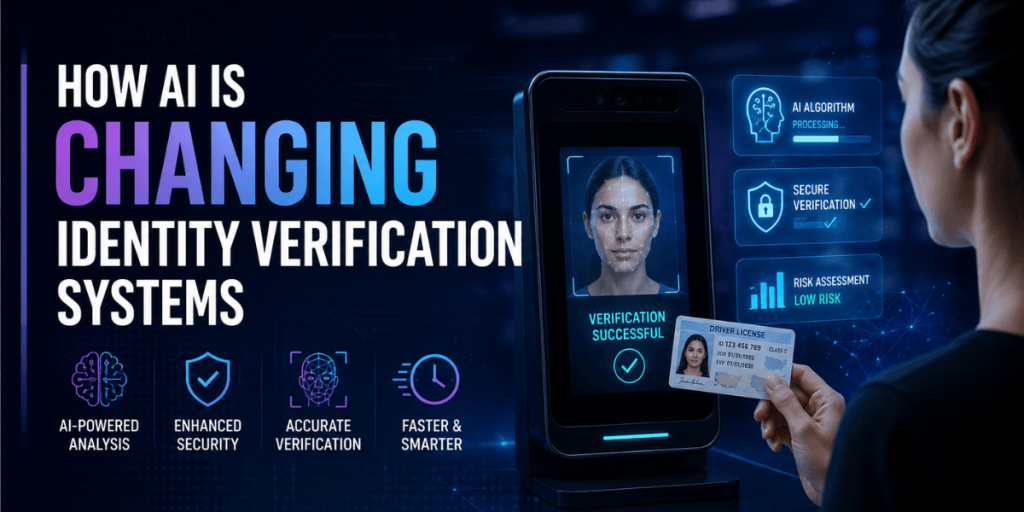
Identity verification has come a long way from the days of simply checking a photo ID at a door. Today, artificial intelligence powers systems that can spot a fake document in seconds, often better than the human eye. The rise of AI in identity verification has transformed how businesses, banks, and governments verify your identity.
This technology works behind the scenes every time you open a bank account online, verify your age for a purchase, or log into a secure system. AI makes this process faster and more reliable through automated analysis and pattern recognition. This transformation is reshaping how people prove their identity in the digital age.
The Evolution of Identity Verification
Identity verification has evolved beyond basic visual checks and now relies on sophisticated AI-powered systems.
Manual Checks and Smart Systems
Traditional identity verification relied on human inspection. Cashiers and bank tellers checked IDs and compared faces manually. These checks were slow and prone to errors. People get tired and miss subtle signs of forgery. Online services made manual verification harder. Businesses could not physically check every customer’s ID worldwide.
Influence of AI
Artificial intelligence brought automation and accuracy to the process. AI systems analyze documents in seconds and check details invisible to the naked eye. The integration of AI in identity verification systems has made remote verification instant and reliable.
The Shift to Digital-First Verification
The pandemic accelerated the move toward digital identity verification. Businesses needed ways to verify customers without in-person contact. AI provided the perfect solution for this challenge. This shift continues to reshape how identity is confirmed worldwide.
Verifying identity today is a whole different game. At IDpapa, we keep pace with these changes to deliver quality products. If you want to buy a fake driver’s license, we are the name you can count on. Connect with us and see what sets us apart!
Core Technologies Powering AI Verification
Modern AI verification relies on several advanced technologies working together seamlessly.
Biometric Authentication
Facial recognition checks a live selfie against the photo on an ID. Advanced systems can tell a real face apart from a deepfake. Systems that combine facial recognition, signature checks, and typing patterns can reach very high accuracy.
Document Analysis and OCR
Optical Character Recognition, or OCR, extracts text from ID documents for review. AI looks for odd fonts and signs that a document has been altered. Some systems can check documents from many countries in just a few seconds.
Behavioral Analysis
One of the key benefits of AI in fraud detection is its ability to analyze behavior patterns using contextual questions and machine learning. The system recognizes data inconsistencies that may indicate fraud and compares information against official records, helping identify suspicious activity with greater accuracy.
Liveness Detection
Liveness detection makes sure a real person is present during the check, not a photo or video. Users might be asked to blink or turn their head. Advanced systems can even catch silicone masks by checking skin texture.
How AI Improves Identity Verification Accuracy
Generative AI has made fake documents more convincing than ever. Fraudsters can now create IDs that look perfect at first glance. However, AI verification systems examine the underlying image structure for traces left by generation algorithms. These traces are invisible to the human eye but clear to trained AI models. Modern systems catch forgeries that would easily pass manual inspection.
AI does not just look at the document itself. It cross-references information against trusted data sources and known fraud signals. A system might check if an ID number matches official records. It might flag if the same photo appears under multiple names. Financial institutions now use AI to stop fraud in real time.
A good example of this is the Commonwealth Bank in Australia monitoring over 80 million signals daily. This has helped cut fraud losses by more than 20% year-over-year in the first half of 2026. The same methodology can be applied to the US.
Traditional Verification vs. AI-Powered Verification
Here’s how the two approaches generally compare.
| Feature | Traditional Verification | AI-Powered Verification |
| Speed | Can take minutes to hours per check | Often completed in seconds |
| Accuracy | Depends on reviewer experience and attention | Generally more consistent, with lower error rates |
| Forgery Detection | Limited to flaws visible to the human eye | Can flag tampering patterns not visible to the naked eye |
| Scalability | Needs a review team to handle volume | Can process large volumes without added staff |
| Document Coverage | Usually limited to familiar document formats | Can learn to read many different document types |
The Benefits of AI in Fraud Detection
AI-powered verification delivers measurable advantages for businesses and consumers alike.
- It reduces false rejections. J.P. Morgan used AI-powered screening for payment validation and cut account rejection rates by 15 to 20 percent, meaning fewer genuine customers get turned away by mistake.
- It helps prevent identity theft. By catching fake or altered IDs before they’re accepted, AI makes it harder for fraudsters to use stolen identities.
- It supports collaboration across borders. In a pilot with 13 global banks, Swift found that AI models trained on shared data were twice as effective at detecting known fraud as models trained on a single bank’s data.
- It saves time. Automated systems can process documents in seconds, cutting the need for large manual review teams.
- It adapts to new threats. AI systems learn from each fraud attempt, so detection improves over time rather than remaining static.
- It protects the customer experience. With fewer delays and false rejections, legitimate users move through verification faster.
Frequently Asked Questions
1. How does AI improve identity verification accuracy?
AI analyzes hundreds of document features that humans cannot see, such as microscopic printing artifacts and digital manipulation traces. It also cross-checks information against multiple databases and known fraud patterns. This multi-layered approach catches forgeries that would pass manual inspection.
2. What technologies are used in AI-based identity verification?
Common technologies include facial recognition, optical character recognition, document analysis, biometric matching, and machine learning models that detect data inconsistencies. Some systems combine multiple biometric methods like facial recognition, signature analysis, and even keystroke patterns for stronger security.
3. Can AI detect fake IDs more effectively than humans?
Yes, AI systems can examine the underlying image structure of a document and detect low-level artifacts left by generation or editing algorithms. These traces are invisible to the human eye. Modern AI verification systems achieve accuracy rates exceeding 98%, significantly outperforming manual inspection.
4. Is AI identity verification safe and secure for users?
Reputable AI verification systems use encryption and privacy-enhancing technologies to protect user data. Systems process documents securely and do not store unnecessary personal information. However, users should always verify they are using legitimate services.
5. How is AI shaping the future of KYC and fraud prevention?
AI enables real-time cross-border verification, reduces false rejections, and adapts to emerging threats. Federated learning allows institutions to collaborate without sharing customer information. The future points toward reusable digital credentials, where users verify once and maintain secure, portable identities across multiple services.
Conclusion
Artificial intelligence has transformed identity verification into a fast, accurate, and scalable process. The rise of AI in identity verification means businesses can now verify customers in seconds, not days. Fraudsters face smarter systems that detect forgeries humans cannot see. As AI technology continues to advance, verification systems will only become more reliable and accessible. The future of identity is smarter, faster, and more secure, powered by artificial intelligence that never stops learning.
Technology changes fast, and so do your options. At IDpapa, we bring expertise to every identification solution we provide. For anyone looking to buy a fake ID, we are here to help. Reach out today and discover a quality that speaks for itself!